If you haven’t heard, the Academy Awards is finally going to recognize the movie stunt community with the Oscar for Achievement in Stunt Design. It’s going to be given out starting at the Oscars on Feb 2028, for the previous year. So movies from 2027 will be the first stunt winners for the Oscars. In honor of this amazing event coming up we will be going back in time and nominating and awarding this award as if it has always been here. Going back in time to nominate the 5 Movies for the Oscar for the Achievement in Stunt Design if the Academy Awards gave out the award in…
1970

NOW HERE’S WHERE YOU COME IN, YOU GET TO VOTE FOR THE WINNER! VOTE BY NAMING YOUR MOVIE CHOICE OUT OF THE 5 NOMINEES BELOW…

- PATTON:
Patton featured significant stunt work, especially in its large-scale battle scenes with tanks and explosions, utilizing professional stunt coordinators and performers like Carey Loftin, Joe Canutt, and others for dangerous sequences, although the focus was on historical realism and spectacle rather than elaborate, fictionalized stunts.

Examples of Stunts & Action:
Tank Battles: The film used M48 Patton tanks (modified to look like German Panzers) in large-scale maneuvers, requiring skilled drivers and stunt people to navigate them safely, as seen in large battle sequences.
Explosions & Debris: The extensive use of explosives in combat scenes necessitated stunt coordinators and special effects teams to ensure safety and capture the action, even requiring specialized camera protection.
Skilled Personnel: Stunt coordinator Joe Canutt and stunt drivers like Carey Loftin (known for Duel) were involved in executing these dangerous moments.

Focus on Realism:
While there were stunts, the film aimed for historical authenticity, using real locations and authentic-looking (though modified) military hardware, so the action was integrated into the believable portrayal of World War II combat.
People Involved in the Stunts & Action:
Yakima Canutt
- Credited with special action sequences on Patton.
- One of the most influential stunt coordinators in film history, especially for horse work and battlefield choreography.
- Helped design mass-movement action that looked dangerous while remaining tightly controlled.
- His methods were ideal for Patton’s sweeping cavalry and troop maneuvers filmed in Spain.
Joe Canutt
- Yakima Canutt’s son and a respected stuntman in his own right.
- Frequently served as a principal double for leading actors in large-scale productions of the period.
- Widely cited as performing dangerous riding and battlefield falls during combat sequences in Patton, including doubling for George C. Scott in select action moments.
Frank McGrath
- Veteran stuntman and actor associated with John Ford films and large outdoor productions.
- Part of the stunt and action unit used for falls, explosions, and background combat during major battle scenes.
Why Patton Is a Stunt Milestone
- Unlike modern war films that rely heavily on CGI, Patton achieved scale through:
- Real tanks and armored vehicles
- Live cavalry and infantry movement
- Carefully choreographed explosions and falls
- Wide-angle staging that demanded absolute precision
- The stunt philosophy was realism through logistics, not chaos. That approach heavily influenced later epics like A Bridge Too Far and Waterloo.
- THE HEROIC ONES
Shaw Brothers film The Heroic Ones features extensive stunt work and is noted for its large-scale action choreography. As a major historical epic of its time, it relied on a massive team of stuntmen and extras rather than modern computer-generated effects.

Notable Stunt and Action Elements
Acrobatic Feats: Leading actors Ti Lung and David Chiang performed agile, athletic maneuvers, including “superhuman” acrobatic leaps facilitated by stunt performers.
Large-Scale Battles: The film features massive melee scenes involving hundreds of real extras and stuntmen instead of CGI crowds.
Weapon Choreography: The movie is credited with establishing the use of spears and heavy staffs as legitimate weapons in the martial arts genre, featuring intricate choreography that required significant physical coordination.
Practical Effects: A key sequence involves a “five-horse quartering” scene, which used practical props, horses, and ropes to simulate the death of David Chiang’s character.

People Involved in the Stunts & Action
Lau Kar-leung
- One of the most important martial arts choreographers in cinema history.
- Served as a martial arts director / action choreographer.
- Brought authentic Hung Gar–influenced movement into stylized wuxia combat.
- Emphasized clear body mechanics, rhythm, and grounded power, even in wire-assisted scenes.
Tong Gaai
- Regular collaborator with director Chang Cheh.
- Helped stage large-scale melee combat, weapon work, and mass battlefield movement.
- Known for managing groups of performers so chaos looked operatic but stayed controlled.
Lau Kar-wing
- Martial artist and frequent Shaw Brothers performer.
- Participated in physically demanding fight scenes, weapon choreography, and falls.
- Part of the extended Lau family action unit that powered many Shaw Brothers productions.
Chang Cheh (Director)
- Chang Cheh’s films required extreme physical commitment from performers.
- He pushed for heroic endurance, real pain, and operatic violence, which heavily shaped stunt execution.
- His insistence on long takes and wide framing placed high demands on stunt teams.
Shaw Brothers Studio
- Maintained an in-house martial arts and stunt training system.
- Performers were often cross-trained as actors, fighters, and stunt doubles.
- This studio system allowed films like The Heroic Ones to stage complex action safely at high speed.
Why The Heroic Ones Matters for Stunts
- The film represents a key moment when:
- Traditional Chinese martial arts blended with cinematic choreography
- Wire work supported movement rather than replacing technique
- Stunt teams became storytelling tools, not just spectacle
- Its influence runs directly into later Shaw Brothers classics and eventually modern Hong Kong action cinema.
- CATCH-22
Catch-22 featured several dangerous and complex aerial stunts, particularly involving its large fleet of B-25 bombers, with famed stunt pilot Frank Tallman performing difficult maneuvers like the perilous formation takeoff sequence, which required planes to take off at tight intervals or crash, a testament to the film’s practical, real-world action.

Key Stunt Elements:
Formation Takeoff: One of the most iconic and dangerous stunts involved numerous B-25s taking off in close succession, with pilots needing incredible skill to avoid collisions, described as one of the most dangerous stunts by pilot Frank Tallman.
Controlled Crashes: The production included deliberate crashes, such as a B-25 that appeared to crash after landing badly, with pyrotechnics and smoke effects used to simulate explosions.
One-Take Sequence: A memorable scene with Colonel Cathcart and Milo Minderbinder walking near a seemingly about-to-crash B-25 showcased actors performing amidst chaotic but controlled aerial activity, highlighting the danger without actual combat.

Expert Pilots: Stunt pilots like Frank Tallman and Jim Appleby were crucial, managing the complex logistics and performing difficult flying maneuvers to capture the intense wartime atmosphere, according to Aero Vintage Books and HistoryNet.
These stunts were essential to creating the film’s realistic, albeit satirical, depiction of wartime aviation, showcasing the era’s practical filmmaking techniques.
People Involved in the Stunts & Action
Frank Tallman
- Served as aerial coordinator and stunt pilot on Catch-22.
- A legendary aviation stuntman and co-founder of Tallmantz Aviation.
- Responsible for coordinating dangerous low-altitude bomber formations, takeoffs, landings, and fly-bys.
- The film used real, airworthy WWII-era aircraft, making Tallman’s role central to both safety and realism.
Tallmantz Aviation
- Provided aircraft, pilots, and aerial stunt coordination.
- Specialized in vintage warplanes and complex formation flying.
- Their involvement allowed Catch-22 to stage some of the largest real bomber sequences ever filmed, with minimal optical effects.
Mike Nichols (Director)
- Not a stunt professional, but Nichols directly shaped how action was staged.
- He favored controlled, methodical aerial choreography rather than spectacle-for-spectacle’s-sake.
- This approach required extreme precision from stunt pilots to match timing, framing, and editorial rhythm.
Richard Sylbert
- Sylbert’s large, practical sets—especially the Mediterranean airfield—enabled ground-based stunt action involving explosions, aircraft movement, and chaotic crowd scenes.
- His designs reduced the need for miniatures and increased reliance on real physical action.
Why Catch-22 Is a Stunt Landmark
- Used real planes, real pilots, real formations
- Filmed at dangerously low altitudes by modern standards
- Relied on aviation stunt expertise rather than visual effects
- The result is an air war that feels absurd, terrifying, and mechanical—perfectly matching the film’s tone.
- THEY CALL ME TRINITY
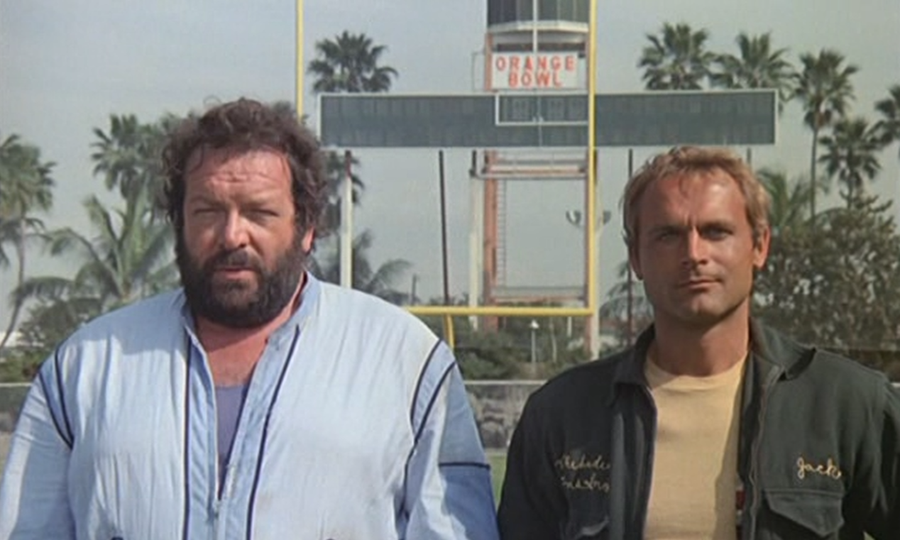
They Call Me Trinity (Lo chiamavano Trinità…) featured stunts, primarily the distinctive slapstick fighting and physical comedy characteristic of Bud Spencer and Terence Hill’s “Trinity” films, involving plenty of exaggerated punches, falls, and bar brawls, alongside typical Western action like gunfights and horse stunts, all performed by stuntmen and the leads. While not known for the death-defying solo feats of someone like Jackie Chan, the movie relied heavily on choreographed physical action and comedic timing.

Key Elements:
Slapstick Fights: The film’s core appeal was the “Farinata” (slapstick) style, with huge, comical punches and people flying around, a staple of Spencer-Hill movies.
Western Action: Expect standard Western fare like gunfights, horse riding, and roughhousing in saloons, often involving coordinated falls and choreographed chaos.
Key People Involved in the Stunts & Action:
Bud Spencer (Carlo Pedersoli)
- Spencer performed most of his own physical comedy and fight work.
- His trademark style—slow, powerful punches, open-handed slaps, and exaggerated knockdowns—was designed to be safe while still looking brutal.
- Because of his size, many scenes were choreographed so opponents “sold” the impact rather than took real hits.
Terence Hill (Mario Girotti)
- Hill was highly athletic and agile and also performed the majority of his own stunts.
- His speed-based choreography contrasted Spencer’s brute force, creating the film’s signature comic rhythm.
- Falls, rolls, horse work, and timing-dependent gags were typically done by Hill himself.
Enzo Barboni (Director)
- While not a stuntman, Barboni was crucial to the stunt design.
- He deliberately staged fights to avoid injury, emphasizing wide framing, rhythm, and reaction shots over realism.
- Barboni’s approach heavily influenced how Italian action-comedy stunts were executed throughout the 1970s.

Why They Call Me Trinity Matters for Stunts
- This film helped redefine stunt work in European cinema by proving that action could be comedic, safe, and character-driven.
- Its influence can be seen in countless later action-comedies where choreography serves tone and personality rather than realism.
- The first of many Trinity films to come and the first of a slew of Spaghetti Western Comedies that would follow.
- LITTLE BIG MAN
Little Big Man featured significant movie stunts, particularly involving legendary stuntman Hal Needham, including a memorable sequence where he jumped from a horse onto a moving stagecoach and then across the horses’ backs, showcasing daring practical effects. The film’s depiction of the Battle of Little Bighorn also involved large-scale, chaotic stunt work with many riders and horses, creating intense realism for the era.

Key Stunt Highlights:
Hal Needham’s Stagecoach Jump: Needham performed a complex stunt where he leapt from a horse onto a moving stagecoach and then across the teams of horses, a famous example of his work.
Battle of Little Bighorn: The chaotic and large-scale nature of the battle scenes relied heavily on numerous stunt performers, horses, and practical action, with stuntmen taking significant risks.
These stunts contributed to the film’s groundbreaking and unconventional approach to the Western genre, emphasizing realism and spectacle.
People Involved in the Stunts & Action:
Joe Canutt
- A leading stunt performer of the period and son of Yakima Canutt.
- Strongly associated with horse falls, cavalry chaos, and battlefield action in late-60s / early-70s Westerns.
- Frequently used as a principal double for lead actors in dangerous riding and fall sequences.
- Production histories routinely cite him as part of the stunt unit on Little Big Man, particularly during the Custer-era battle scenes.
Yakima Canutt
- While not always listed in on-screen credits, Canutt’s methods and team heavily influenced the film’s action.
- His pioneering techniques for:
- Controlled horse falls
- Riders bailing safely at speed
- Large-scale Western combat staging
- Were the industry standard and directly shaped how Little Big Man’s cavalry scenes were executed.
Richard Farnsworth
- Appears on screen in the film and was also a former elite stuntman before transitioning into acting.
- While not credited as a stunt performer here, Farnsworth was often used for physically demanding riding and action beats due to his deep stunt background.
- His presence added realism to horseback and frontier sequences.
Hal Needham
Performed high-risk horseback stunts, including:
- Falls from moving horses
- Cavalry charge chaos beats
- Riders being knocked down or unhorsed during battle scenes
Worked as part of the core Western stunt pool used for large-scale frontier and cavalry sequences.
Helped sell the film’s deliberately messy, anti-heroic battle realism, especially during the Custer-related sequences.

Arthur Penn (Director)
- Penn played a major role in shaping the stunt philosophy of the film.
- He pushed for controlled realism rather than traditional heroic Western action.
- Battle scenes emphasize confusion, panic, and tragic scale—requiring precise stunt coordination to look chaotic without becoming unsafe.
Why Little Big Man Is Notable for Stunts
- Unlike classic John Ford Westerns that romanticized cavalry action, Little Big Man:
- Shows battle as disorder, not choreography
- Uses real horses, riders, and terrain
- Relies on stunt performers to sell danger without glamorizing it
- That approach influenced later revisionist Westerns like McCabe & Mrs. Miller and The Outlaw Josey Wales.
And the winner for the Oscar for Achievement in Stunt Design in 1970 is…
UP TO YOU!———————————————-VOTE NOW IN THE COMMENTS!
WHICH FILM DESERVES THE OSCAR FOR 1970?

Interesting to note:
Yakima Canutt won an honorary Oscar in 1967 (for achievements in 1966) for his groundbreaking work as a stuntman and for developing safety devices, recognized at the 39th Academy Awards. He received the special award for his contributions to film, acknowledging his creation of the modern stunt profession, as stated in his 1967 Oscars acceptance speech and noted by the Academy Awards Acceptance Speech Database and the National Cowboy & Western Heritage Museum.
Awarded: Honorary Academy Award
Year: 1967 (for the 1966 film year)
Reason: Achievements as a stuntman and for developing safety devices for stunt professionals.